Janani Suraksha Yojana: Benefits, Eligibility & Registration Process
Janani Suraksha Yojana (JSY) explained. Discover benefits, eligibility, and how to register for this government scheme supporting safe childbirth.
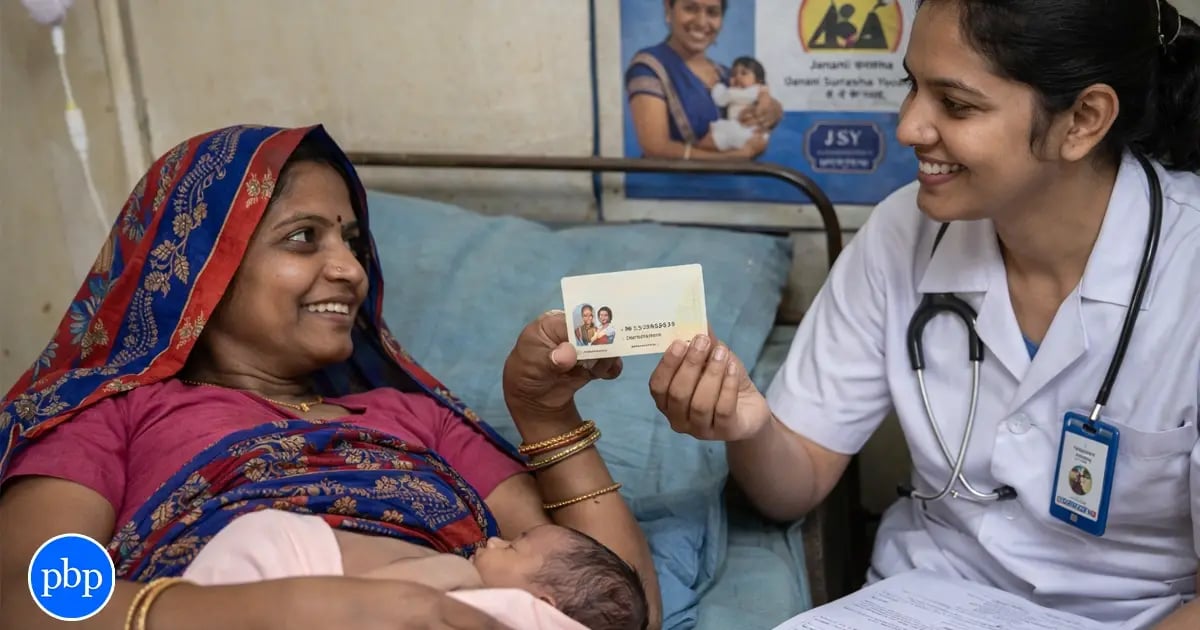
In 2005, the government launched a new scheme, Janani Suraksha Yojana (JSY) under the National Rural Health Mission (NRHM) - now, National Health Mission (NHM). This scheme was mainly introduced to promote safe childbirth in health facilities.
It was to encourage pregnant women, especially those from poorer and rural households, to deliver their babies in hospitals or public health settings instead of their homes, so they get skilled care, and newborns get the best start.
Below you will find a clear explanation of what JSY offers, who can claim it, how it is delivered, and some practical tips for applying.
What is Janani Suraksha Yojana?
JSY works to achieve these main goals:
- Boost hospital deliveries so that skilled attendants can handle every birth.
- Lower maternal and newborn deaths by keeping facility births affordable and reachable.
- Connect community health workers like ASHAs with pregnant women for full antenatal, delivery, and postnatal care.
Support comes through
- Cash incentives are paid directly to mothers.
- Payments to ASHA workers who assist with arranging facility deliveries.
- Tie-ups with programs like JSSK to cover transport, drugs, and other expenses.
How to Apply for Janani Suraksha Yojana Online Registration
Many beneficiaries search for how to apply for Janani Suraksha Yojana online registration. There is no single national portal for but the application procedure is assisted through government health institutions and local health workers.
- Register Pregnancy at an Approved Health Facility: As soon as you find out about your pregnancy, enrol yourself at the local PHC, CHC or government hospital.
- Contact an ASHA Worker: An ASHA Worker can guide you through the registration process and help you to make arrangements for institutional delivery and antenatal care.
- Submit Required Documents: Submit all the required documents like proof of identity, Aadhaar details along with bank account details.
- Complete Beneficiary Verification: The applicant's eligibility and supporting documents are verified thoroughly by the health authorities.
- Link Bank Account Details: Ensure that your bank account is active and linked with Aadhaar, wherever possible, to facilitate Direct Benefit Transfer (DBT).
- Track Application Status: Applicants can contact their PHC, ASHA worker, or district health office to check the status of their application.
- Receive Benefits After Institutional Delivery: The incentive amount under the JSY is generally directly credited to the bank account of the beneficiary after the institutional delivery and completion of verification procedures.

JSY Benefits - What Money and Services You Actually Get?
Let’s take a look at the perks pregnant women get under this scheme:
1. Cash Incentive to the Mother
JSY provides a one-time cash amount to mothers who deliver in a recognised public or private health facility. The actual JSY amount is based on your location (rural or urban) and the category of your state (Low Performing State (LPS) or High Performing State (HPS)). Broadly speaking, the pattern is:
- Low Performing States (LPS): Higher incentive amounts to encourage institutional delivery.
- High Performing States (HPS): Smaller incentive amounts (because institutional delivery rates are already higher).
Different states may set specific payouts, and revisions can happen through official NHM orders. Check your state NHM page or local facility for the current JSY amount.
2. Payment to ASHA and Link Workers
ASHAs (Accredited Social Health Activists) who accompany or motivate pregnant women to deliver in institutions receive an incentive from the programme. This is a crucial component of the model. It builds a local and trusted connection between the health system and pregnant women.
3. Complementary Free Entitlements under JSSK
JSY is often used together with Janani Shishu Suraksha Karyakram (JSSK), which provides free delivery, free drugs and diagnostics, free transport (to and from the health facility), and free treatment for sick newborns. That means combining JSY cash with JSSK entitlements can make institutional delivery effectively cost-free for many families.
4. Reduced Out-of-Pocket Costs and Better Postnatal Care
By encouraging facility births, JSY helps ensure immediate newborn care (breastfeeding support, immunisation) and postnatal checks - all of which reduce the longer-term cost and health burden for mothers and infants.
Janani Suraksha Yojana Eligibility Criteria
The eligibility criteria for Janani Suraksha Yojana (JSY) vary slightly across states. However, the following conditions generally determine who can avail of the scheme's benefits.
| Eligibility Requirement | Details |
| Pregnant Women | The scheme is intended for pregnant women who opt for institutional delivery. |
| Eligible Categories | Priority is given to women from Below Poverty Line (BPL) households, Scheduled Caste (SC), Scheduled Tribe (ST), and other vulnerable groups. |
| Institutional Delivery | The incentive will be available to the beneficiary if they deliver in a government hospital or an empanelled private health facility. |
| Age Criteria | Generally applicable to women aged 19 years and above, subject to state-specific guidelines. |
| Documentation | Pregnancy registration records, Aadhaar card, bank account details and other supporting documents are required. . |
Documents Required for Janani Suraksha Yojana Registration
Applicants should keep the following documents ready while applying for Janani Suraksha Yojana online registration:
- Aadhaar Card
- Identity proof (Voter ID, PAN Card, etc.)
- Residence proof
- Bank account details and passbook copy
- Pregnancy registration records or antenatal card
- BPL card or income certificate, where applicable
- SC/ST certificate, if applicable
- Passport-size photographs, if required by local authorities
Janani Suraksha Yojana Online Registration in Punjab
Women looking for information about the Janani Suraksha Yojana online registration Punjab should note that the registration procedure generally facilitated by government health facilities and community health workers.
The generally involves:
- Register the pregnant woman at the nearest government hospital, PHC, or CHC.
- Verification of documents and eligibility.
- Support and guidance provided by ASHA Workers.
- Delivery at a health facility with a valid accreditation.
- The incentive amount will be directly credited to beneficiary’s bank account.
The beneficiaries can also approach the district health offices and the local government hospitals for assistance on registration and payment status.
Janani Suraksha Yojana Apply Online in West Bengal
For beneficiaries looking for information on Janani Suraksha Yojana apply online West Bengal, the registration process is generally managed through government health facilities and local health authorities.
The process typically includes:
- Registering the pregnancy at a government health facility.
- Completing document verification.
- Visiting for the recommended antenatal check up.
- Selecting an institutional delivery.
- Receiving the incentive amount through DBT.
Women can contact ASHA workers, PHCs and district health authorities for guidance on how to register and receive the benefits.
Common Reasons Janani Suraksha Yojana Applications Get Rejected or Delayed
Generally the scheme aims to provide timely financial benefits. Still, certain issues can cause delay or rejection of applications.
Typical reasons include:
- Wrong or incomplete documents.
- Bank Account details mismatch with Aadhaar.
- Incomplete Pregnancy registration.
- No institutional delivery records.
- Delay in verification of beneficiaries.
- Submit the necessary documents before specified time.
Janani Suraksha Yojana vs Maternity Health Insurance
Janani Suraksha Yojana provides financial assistance for institutional deliveries while maternity health insurance offers broader coverage for pregnancy-related medical expenses in India .
| Particulars | Janani Suraksha Yojana | Maternity Health Insurance |
| Type | Government scheme | Insurance product |
| Coverage | Cash assistance for institutional delivery | Hospitalisation and maternity expenses |
| Eligibility | Based on government eligibility criteria | Based on policy terms and conditions |
| Premium | No premium payable | Requires premium payment |
| Purpose | Promote institutional deliveries | Provide financial protection against maternity expenses |
Additionally, families may wish to consider maternity health insurance in India and the best health insurance plans for families to boost the advantages that government healthcare provides.
How Does JSY Promote Maternal Health?
Jnani Suraksha Yojana is not just about cash transfer. It means that there is a real support system for mothers-to-be. The programme trains a lot of ASHA workers and they become like neighbourhood health champions. They check for issues such as high blood pressure or anaemia, and make sure families get connected to the right hospitals when needed.
This hands-on community approach makes JSY a full-education package. ASHAs teach simple things like - keeping clean, planning family spacing, and knowing warning signs during pregnancy. It’s not only about money. It is about building habits that save lives every day.
The results speak for themselves. Since it started, JSY has helped over 10 crore women, and hospital births have shot up big time.
It is important to note that challenges also exist - delays in payments or awareness gaps in far-flung villages, etc. But they are fixed by tweaks like Aadhaar linking, mobile apps. During COVID, JSY adapted with home deliveries for emergencies, showing flexibility.
Typical JSY Cash Amounts
The financial support provided under Janani Suraksha Yojana depends on the location of the mother and the category of the state under the scheme. Low performing states tend to offer relatively higher incentive to promote institutional deliveries particularly in rural areas. Urban beneficiaries in these states receive a relatively lower amount.
In states where institutional deliveries are already common, the incentive is more modest, with rural beneficiaries receiving slightly more support than those in urban areas. Some states also extend a small assistance for home deliveries when they are conducted under specific conditions and reported through the health system.
Since the incentive structure is reviewed from time to time and implementation varies across states, the exact amount credited can differ. It is always advisable to check the current entitlement with the nearest health facility or the official state NHM portal at the time of registration.
Other Government Schemes for Mothers and Families
Besides the Janani Suraksha Yojana, the government also runs a number of other programs that help and protect vulnerable homes financially.
Some notable schemes include:
- Pradhan Mantri Matru Vandana Yojana (PMMVY)
- Janani Shishu Suraksha Karyakram (JSSK)
- Ayushman Bharat Pradhan Mantri Jan Arogya Yojana (PM-JAY)
- Government life insurance schemes in India
- PMJJBY and PMSBY social security schemes
All these initiatives towards improving healthcare access, reducing the financial burden and improving social security for pregnant women and their families.
JSY changed the conversation in India about childbirth: it uses a straightforward cash incentive, backed by community health workers, to shift births from home to institutions where trained staff and emergency care are available. For many families, this has meant safer deliveries, lower newborn deaths, and less catastrophic spending when complications occur. If you or someone you know is pregnant and from a vulnerable household, check JSY eligibility at the nearest public health facility. It could make the difference between an anxious home birth and a safer, supported delivery.
Disclaimer* :- The information provided here is for general awareness only. It does not constitute professional advice. While care has been taken to ensure accuracy, readers are advised to consult a qualified professional before making any decisions.
FAQs
What is Janani Suraksha Yojana?
Janai Suraksha Yojana is a government policy that encourages people for institutional deliveries and it also reduces the maternal and infant mortality rate with financial and healthcare support.
How can I apply for Janani Suraksha Yojana online?
You can register through government health facilities with the help of ASHA workers and submit the necessary documents for verification.
What documents are required for Janani Suraksha Yojana registration?
Generally Aadhaar card, identity proof, bank account details, pregnancy registration records and BPL or caste certificates where applicable need to be presented by the applicants.
Who is eligible for Janani Suraksha Yojana?
Pregnant women of eligible categories are particularly from vulnerable and low-income families who choose institutional delivery.
What benefits are available under Janani Suraksha Yojana?
The scheme provides cash incentives, help from ASHA workers and free maternal healthcare services under related government programmes.
How is the JSY benefit amount paid?
The amount of JYS benefit will be transferred to the bank account of the beneficiary through Direct Benefit Transfer (DBT).
Can I apply for Janani Suraksha Yojana in Punjab online?
Registration process is usually carried out in government health facilities and local health authorities of Punjab.
Can I apply for Janani Suraksha Yojana in West Bengal online?
West Bengal resident women who are eligible can sign up at government health centers and get help from ASHA workers the local health authority.
What is the difference between Janani Suraksha Yojana and maternity health insurance?
JSY is a government program while maternity health insurance is a type insurance of that covers medical costs related to pregnancy.
How can I check my Janani Suraksha Yojana application status?
Those who want to check on their application and payment can call ASHA workers, PHC, government hospital, or the district health office.




Comments (0)
Leave a Comment
No comments yet. Be the first to comment!