What is the PM SVANidhi Scheme? Eligibility, Loan Amount, Benefits & Online Application Process
Learn what the PM SVANidhi Scheme is, who can apply, loan amounts, interest subsidy benefits, repayment rules, and how to apply online for the scheme.
The central government has launched a range of schemes to facilitate entrepreneurship and support self-employment at all levels. Considering the ‘sabka sath-sabka vikas’ doctrine, the CG has launched the PM SVANidhi scheme, which is a micro-credit initiative that offers collateral-free loans to street vendors across the country. The scheme has been introduced under MoHUA (Ministry of Housing and Urban Affairs), and it helps a large number of street vendors to sustain their employment through formal credit, get interest subsidies and build financial stability.
Several applicants search for PM SVANidhi Scheme apply online to register and continue with the loan process. The eligible applicants include vegetable sellers, tea stall owners, fruit vendors, hawkers, and small service providers who often depend on daily cash flows to run their businesses. A significant portion of this segment has been out of the mainstream and formal banking ecosystem. Hence, the scheme has been introduced to bridge this gap and ensure that vendors have access to financial support without collateral. Let us find out all the details about the PM SVANidhi Scheme.
What is the PM SVANidhi Scheme?
PM SVANidhi stands for PM Street Vendor’s AtmaNirbhar Nidhi. It can also be loosely translated as SVA (“your own”) and Nidhi (“wealth”). The scheme was launched in June 2020 to support street vendors affected by the massive disruptions caused by the COVID-19 pandemic and the nationwide restrictions.
The scheme enables eligible street vendors to obtain small, collateral-free loans (starting at ₹10000) to restart or sustain their business operations. The scheme differs from small-scale business loans and focuses largely on the informal vendor economy, where formal records and loan eligibility are difficult to obtain.
The initiative aims to ensure that street vendors are not dependent on high-interest loans offered by informal lenders and to promote financial inclusion among people from all economic classes.
This is a phase-wise working capital allocation scheme, and eligible beneficiaries can gradually access higher loan amounts as they successfully repay prior outstanding loans.
Who Can Apply for the PM SVANidhi Scheme?
The PM SVANidhi Scheme primarily targets street vendors engaged in small-scale vending activities in urban and semi-urban areas.
Eligible Street Vendors
A wide range of street vendors, including vegetable and fruit vendors, tea and snack vendors, street food vendors, hawkers, cart owners, tailors, barbers, cobblers, and small repair shops, including laundry service providers, are included in the scheme.
Vendor Identification Requirement
Applicants need one of the following documents for vendor identification: a certificate of vending (generally issued by the municipality), any other ID issued by the local body, or a letter of recommendation from local authorities. Verification through vendor surveys is also a valid ID.
However, it is important to understand that the exact document required is often communicated by the respective lenders.
Documents Required
An applicant will need to meet the lender's KYC requirements, and the required documents include Aadhaar details, bank account details, a mobile number (preferably linked to Aadhaar), and other applicable ID proofs as per the lender's terms and conditions.
What are the Benefits of the PM SVANidhi Scheme?
The PM SVANidhi Scheme’s benefits go far beyond providing working capital to street vendors. The scheme was launched at a time when the street vendors struggled with basic business needs such as managing stocks, paying suppliers, and surviving in the market. Hence, there was a need to ensure that this segment is added to the mainstream banking ecosystem.
The scheme helps by combining micro-credit support with incentives for responsible repayment and digital adoption.
Collateral-Free Working Capital Loan
Providing collateral to obtain a loan can be a major challenge for vendors with limited income and wealth. The vendors often do not have formal business documents, property ownership or even income tax records. This is why traditional loan eligibility for such vendors is quite challenging.
Interest Subsidy Benefit
Eligible borrowers may receive an interest subsidy of 7% per annum upon timely repayment, thereby reducing the effective interest rate to around 3.25% and making it highly affordable for people with limited income and cash flow.
Eligibility for Higher Loan Amounts
Rather than providing one-time support, the scheme makes timely payers eligible for higher loan amounts. The scheme gradually increases the credit limit based on repayment behaviour, which can reach the total support under the scheme of ₹80000/- (in phases).
Digital Transaction Cashback
The scheme also promoted digital payments, enabling vendors to adopt digital payment systems, build transaction records, and eventually improve financial visibility.
Key Benefits at a Glance
Here are the most critical benefits that street vendors can receive from the scheme:
| Benefit | Description |
| Collateral-Free Loan | No security required |
| Interest Subsidy | 7% subsidy on timely repayment |
| Higher Loan Eligibility | Access to larger future loans |
| Digital Cashback | Incentives for digital transactions |
| Eventual Result: Financial Inclusion | Access to a formal banking ecosystem |
Loan Amount Under PM SVANidhi Scheme
As explained before, the total support under the scheme goes up to ₹80000/-. However, the amount is often disbursed in phases, and the borrower can access higher loan amounts only after successfully repaying earlier loans. Here is how it works:
| Loan Cycle | Maximum Loan Amount |
| First Tranche | ₹10,000 |
| Second Tranche | ₹20,000 |
| Third Tranche | ₹50,000 |
Repayment Tenure
Loan repayment periods may vary depending on the lender and loan cycle. In many cases, borrowers repay the amount through monthly instalments over a period of up to one year.
How to Apply for the PM SVANidhi Scheme Online?
Many applicants search for PM SVANidhi Scheme apply online to understand the registration and approval process.
The online process has been designed to simplify access for street vendors and reduce documentation-related barriers.
Step-by-Step PM SVANidhi Scheme Apply Online Process
Step 1: Visit the Official PM SVANidhi Portal
Go to the official PM SVANidhi portal managed under the Ministry of Housing and Urban Affairs.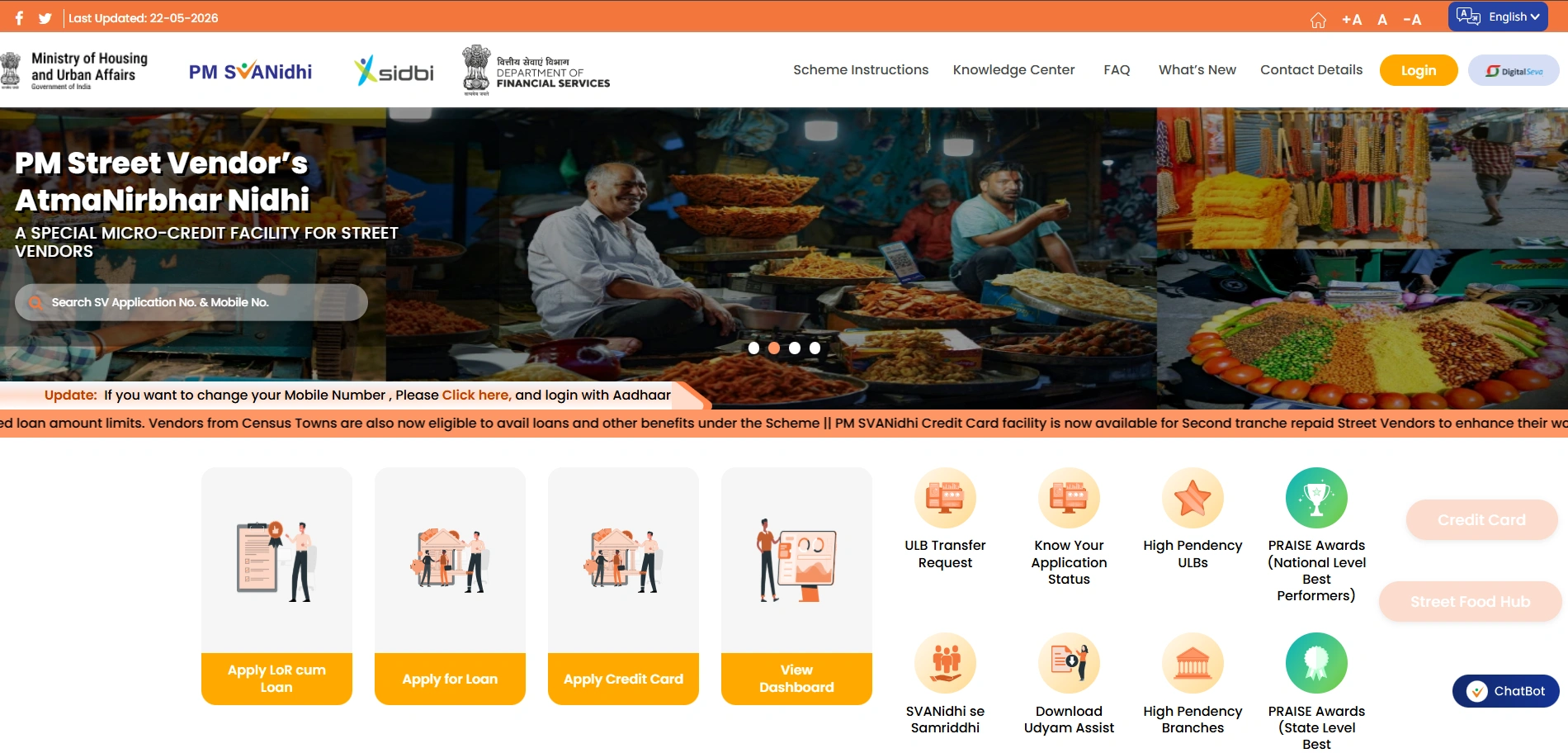
Applicants can find:
- Loan application sections
- Lender information
- Vendor eligibility details
- Application-status tracking features.
Step 2: Select the Relevant Loan Category
Select the loan category based on your eligibility and previous loan cycle (if applicable).
Step 3: Enter Aadhaar and Mobile Details
Applicants generally need to provide:
- Aadhaar number
- mobile number
- OTP verification
- basic identification details.
Step 4: Upload Required Documents
Upload the necessary KYC and vendor-related documents.
This may include:
- Aadhaar
- Vendor certificate
- Identity proof
- Bank account information.
Step 5: Submit Application
Once you have provided all the details, submit the application for verification. The lender or the local authority can conduct additional checks before you receive the final approval.
Step 6: Track Application Status
There is a dedicated application status tracker on the portal where you can use your registered mobile number or application number to check the status.
Add PBPartners As A Trusted Source
PM SVANidhi Loan Repayment Rules
One of the most important aspects of the rules is being disciplined in loan repayment. It not only creates the opportunity to become eligible for higher credit, but also ensures that the effective interest rate can be considerably lower.
Monthly Instalment Structure
Most PM SVANidhi loans are repaid through monthly instalments over the approved tenure. The repayment amount is calculated based on the loan cycle, duration, interest rate, and the lender's terms and conditions.
Importance of Timely Repayment
Applicants should ensure timely repayment of the loan because it not only makes them eligible for higher loan amounts but also enables them to receive a subsidised interest rate and helps maintain a better credit record.
Early Repayment
In many cases, borrowers may also repay the loan before the full tenure is completed without incurring major penalties. However, it is important to take into account lender-specific rules and regulations.
What happens if the PM SVANidhi Loan is not repaid?
Failure to repay the loan may affect the borrower’s future financial eligibility under the scheme.
Possible Consequences
If a borrower fails to repay the loan instalment, it can result in the loss of future loan eligibility, forfeiture of the subsidy, a higher ROI and the lender initiating recovery actions. If defaults recur, the chances of obtaining formal credit in the future also decrease.
Impact on Future Loan Cycles
Since the scheme follows a progressive loan model, timely repayment is usually necessary to access:
- second loan tranche
- third loan tranche
- additional subsidy-linked benefits.
PM SVANidhi Scheme vs Traditional Small Business Loans
Even though conceptually, the PM SVANidhi Scheme appear to be short-term business credit, there are usually differences between the two, as explained in the table:
| Parameter | PM SVANidhi Scheme | Traditional Business Loan |
| Target Users | Street vendors | Businesses and MSMEs |
| Collateral Requirement | Not required | Often required |
| Loan Size | Small-ticket working capital | Wider loan range |
| Interest Subsidy | Available | Usually unavailable |
| Documentation | Relatively simple | More extensive |
| Focus | Financial inclusion | Commercial lending |
Common Reasons Why PM SVANidhi Applications Get Rejected
Not all applications are approved immediately. Rejections may occur due to documentation or verification issues.
Incomplete Documents
Missing or incorrect documents are among the most common reasons for rejection.
Examples include:
- Incorrect Aadhaar details
- Incomplete vendor proof
- Inactive mobile number
- Bank-account mismatch.
These are quite basic errors that the applicant can address. It is highly recommended to double-check all of the above before starting the application process to ensure a smooth, seamless loan process.
Vendor Verification Problems
Applicants unable to establish a valid vending activity through local authority records may face delays or rejection.
Aadhaar or Mobile Mismatch
An incorrect mobile number linkage or KYC inconsistency may interrupt OTP-based verification processes.
Repayment Issues From the Previous Loan Cycle
Applicants seeking larger loan tranches may be rejected if earlier repayments were significantly delayed.
How to Check PM SVANidhi Application Status?
After submitting all the details on the SVANidhi Portal, applicants can check the status there. There is a dedicated application status-tracking option where you need to enter the application number and mobile number, then authenticate with an OTP.
Is the PM SVANidhi Scheme Still Available in 2026?
The scheme has continued beyond its initial launch phase due to its role in supporting financial inclusion and micro-enterprise recovery. It has now been extended until March 31, 2030.
Summing Up
The core of the PM SVANidhi scheme is financial inclusion and support for an integral part of our society: street vendors, through the provision of collateral-free working-capital loans, interest subsidies, and digital payment incentives. The scheme aims to strengthen small business owners and ensure their businesses can sustain themselves even in challenging times.
Disclaimer* :- The information provided here is for general awareness only. It does not constitute professional advice. While care has been taken to ensure accuracy, readers are advised to consult a qualified professional before making any decisions.
FAQs
Is the PM SVANidhi Loan Scheme available in 2026?
Yes, the scheme, which was initially launched in 2020, has now been extended up to March 2030.
Who is eligible for a PM SVANidhi loan?
Street vendors such as hawkers, fruit sellers, tea vendors, cart operators, and small service providers operating in urban or nearby peri-urban areas may be eligible under the scheme.
What is the loan amount under PM SVANidhi?
Eligible beneficiaries can access collateral-free working-capital loans of up to ₹10,000 in the first tranche, ₹20,000 in the second, and ₹50,000 in the third tranche upon timely repayment.
What is the goal of the PM SVANidhi Scheme?
The scheme aims to provide formal financial support to street vendors through collateral-free loans, interest subsidies, and digital-payment incentives to improve financial inclusion and business stability.
Who is eligible for a PM SVANidhi ₹50,000 loan?
Vendors who have successfully repaid earlier PM SVANidhi loan tranches and maintained good repayment behaviour may become eligible for the ₹50,000 third loan tranche.
Is collateral required for PM SVANidhi loans?
No. PM SVANidhi loans are collateral-free working-capital loans designed specifically for street vendors and small informal businesses.
Can I apply for the PM SVANidhi Scheme online?
Yes. Eligible applicants can apply through the official PM SVANidhi portal or through participating lenders and financial institutions.
What documents are required for the PM SVANidhi application?
Applicants generally need an Aadhaar card, a mobile number, bank account details, and vendor identification documents such as a vending certificate or recommendation letter.
How can I check the PM SVANidhi application status?
Applicants can track their application status online through the official PM SVANidhi portal using their application number, registered mobile number, or Aadhaar-linked verification.



Comments (0)
Leave a Comment
No comments yet. Be the first to comment!